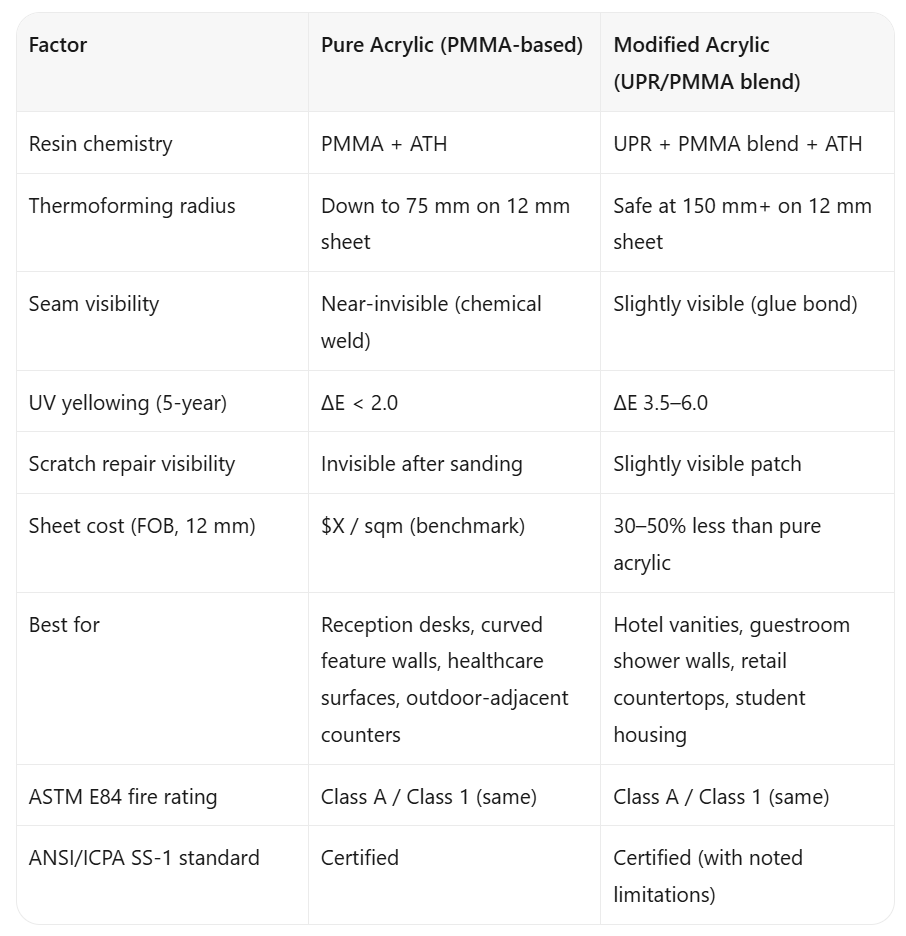
If you only remember three things: (1) pure acrylic thermoforms tighter and yellows slower; (2) modified acrylic costs roughly 30–50% less and is good enough for most vanities; (3) the smart spec is rarely "all one" — we routinely mix both on the same project. Below is the field-level breakdown Guangdong Wiselink Ltd. gives buyers before they commit to a container.
Most buyers ask us "which is better?" The honest answer is "which is right for this surface." After supplying solid surface sheets to hotels, senior-living communities, and dental clinics across the U.S. for over a decade, we've stopped treating this as a purity contest and started treating it as a spec decision.
Pure (or "100%") acrylic solid surface is built on polymethyl methacrylate (PMMA) resin bonded with alumina trihydrate (ATH) filler. Think Corian-class chemistry. The resin is the same family as Plexiglas, which is why it behaves the way it does: it thermoforms cleanly, takes a near-invisible seam, and shrugs off UV yellowing better than anything else in this category.
At Guangdong Wiselink Ltd., our pure acrylic sheet runs through a longer cure cycle and a tighter calendering tolerance — typically ±0.2 mm on a 12 mm slab. That tolerance matters when you're doing a continuous 20-foot reception desk with two heat-bent returns. You don't get away with sloppy sheet on a seamless curve.
Key characteristics of pure acrylic:
In short: pure acrylic is what you spec when the surface has to last 15+ years with zero excuses.
Modified acrylic is an acrylic-modified unsaturated polyester (UPR) blend with ATH filler. Translation: it keeps some of the acrylic's workability but leans on cheaper polyester resin to hit a price point. The "modified" part isn't marketing fluff — it genuinely bridges the gap between brittle polyester and premium acrylic.
Wiselink's modified acrylic line uses a roughly 30–40% PMMA / 60–70% UPR resin split, calibrated to preserve decent thermoforming while keeping sheet cost competitive. For a hotel chain ordering 500 vanities, that price gap adds up fast.
Key characteristics of modified acrylic:
The real-world distinction: modified acrylic is perfectly fine for 90% of hotel bathroom vanities — the ones tucked in interior bathrooms with no direct sunlight, used by guests who won't be sanding their own countertops. It's not "cheap." It's "appropriate."
Pure acrylic won on a 340-key Florida resort. The lobby reception desk was a single continuous serpentine — 28 feet of curved front edge with two 90° returns. Modified acrylic would have whitened at the bend radius. Pure acrylic bent clean and the seams disappeared after the fabricator's final sanding pass. Five years in, under Florida sun pouring through floor-to-ceiling glass, the desk still reads as one piece.
Modified acrylic won on a 12-property senior-living portfolio in Arizona. 1,200 vanities total. The bathrooms had no windows, the countertops were simple rectangles with integrated bowls, and the budget difference between pure and modified acrylic paid for upgraded hallway handrails. The owner's facility manager told us: "Nobody's thermoforming a vanity top. Give me the one that doesn't yellow in a windowless bathroom and costs less." Fair point.
We mixed both on a Chicago dental clinic chain. Pure acrylic for the sterilization rooms (chemical exposure, constant cleaning with CaviWipes). Modified acrylic for the patient-facing countertops (low abuse, no solvents). The spec looked inconsistent on paper but made perfect sense in practice.
Q: Can you tell the difference by looking at a finished countertop? A: On day one, no. After 3–5 years, maybe — especially if the surface gets sun. Pure acrylic holds its color; modified acrylic can shift toward warm-yellow. But in a windowless bathroom, even an experienced fabricator would struggle to tell them apart.
Q: Is modified acrylic "fake" solid surface? A: No. It meets the same ANSI/ICPA SS-1 standard for solid surface materials. It's not a counterfeit — it's a different formulation for a different use case. Calling it fake is like calling a Toyota Camry a fake car because a Lexus exists.
Q: Does Wiselink offer both? A: Yes. Guangdong Wiselink Ltd. manufactures both pure acrylic and modified acrylic solid surface sheets in standard sizes (3050×760 mm, 3680×760 mm) and custom dimensions. We ship both grades in the same container to keep logistics simple for multi-grade projects.
Q: Which one is easier to fabricate? A: Pure acrylic is slightly more forgiving during thermoforming and seam work. Modified acrylic requires a bit more care on tight bends but is otherwise straightforward. Any fabricator who's worked with solid surface before can handle both.
Q: What about polyester solid surface? A: Polyester (non-acrylic) solid surface is a third, lower-tier category. It's cheaper still but thermoforms poorly, yellows fast, and repairs visibly. We generally don't recommend it for commercial projects — it's more of a budget residential product. If you're comparing acrylic vs modified acrylic, polyester is a step below both.
Copyright © Guangdong Wiselink Ltd. -- Privacy Policy
 EN
EN