
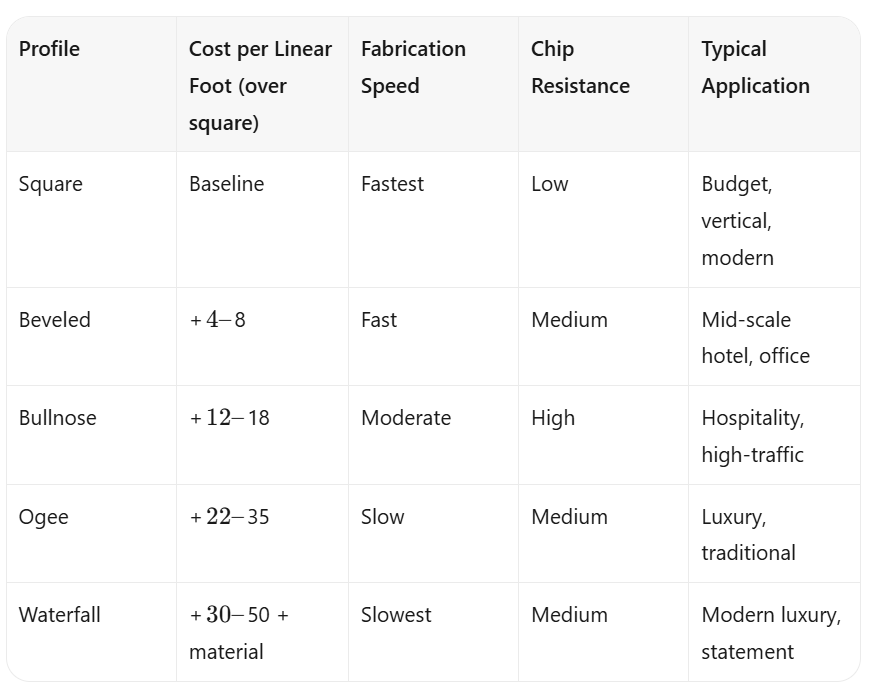
Edge profile is one of the most visible decisions you'll make on any solid surface project. It affects the look, the cost, and the maintenance. A square edge costs the least but chips more easily. A bullnose adds 12–18 per linear foot but hides wear better. Waterfall edges — where the material wraps down the side — can double your material cost but create a striking modern look. I've fabricated thousands of edges over 12 years at Guangdong Wiselink Ltd., and this guide covers what each profile costs, how it's made, and where it belongs.
The edge is the first thing people touch. A guest runs their hand across a hotel vanity, a restaurant patron rests their arm on a bar top — that's the edge they feel. It's also the most vulnerable part of any countertop. Chips, dings, and wear almost always start at the edge.
Solid surface has an advantage over natural stone here: it's homogeneous throughout. A chip in granite means a visible repair line. A chip in solid surface can be sanded and polished back to seamless. But the right edge profile reduces the chance of damage in the first place.
What it is: A clean 90-degree edge with a very slight radius — typically 1mm or less — just enough to knock off the sharp corner.
Cost: Baseline — no additional fabrication cost beyond standard finishing.
Fabrication complexity: Low. The fabricator cuts to dimension, routes the edge square, and sands smooth.
Best applications:
Watch out for: Square edges are prone to chipping in high-traffic areas. We don't recommend them for hotel guest room vanities — housekeeping carts bump edges regularly. For a 200-room property we supplied last year, the owner spec'd square edges. After 18 months, 14% of vanities had visible edge damage.
What it is: The top edge is cut at a 45-degree angle, usually 1/8" to 1/4" deep. Creates a chamfer where the horizontal meets the vertical.
Cost: +4–8 per linear foot over square edge.
Fabrication complexity: Low to medium. Requires a second router pass at the correct angle. Consistent bevel depth takes practice.
Best applications:
Why it works: The bevel catches light differently than a flat edge, giving a subtle detail line. It's more chip-resistant than a square edge because the angled corner distributes impact. We've been using beveled edges on the Hampton Inn & Suites program for 3 years — damage rate dropped to under 3%.
What it is: A fully rounded edge — typically a half-circle profile. The radius varies from 1/4" to 1" depending on the look.
Cost: +12–18 per linear foot over square edge.
Fabrication complexity: Medium. Requires a roundover bit and multiple sanding stages from 80 to 600 grit to get a polished finish on the curve.
Best applications:
Why it dominates hospitality: Bullnose is the safest edge profile. No sharp corners, no hard angles. The rounded surface hides minor chips and dings. Housekeeping carts, dropped toiletries, cleaning chemicals — bullnose takes it all. In the 300-room Marriott project we supplied, every guest bathroom vanity had a 3/4" bullnose. After 4 years, less than 2% needed edge repair. That's the track record.
What it is: An S-curve profile — concave upper curve flowing into a convex lower curve. Classic, ornamental, complex.
Cost: +22–35 per linear foot over square edge.
Fabrication complexity: High. Requires specialized profile tooling, multiple routing passes, and extensive hand-sanding on the curves. A skilled fabricator produces 3–4 ogee edges per hour vs. 12–15 bullnose edges.
Best applications:
The reality check: Ogee edges look spectacular but they're expensive and harder to maintain. Dust collects in the S-curve. Touch-up refinishing is more difficult. For a Ritz-Carlton lobby we worked on, the ogee reception desk took 3 days just for edge finishing. Beautiful result. But the owner budgeted $9,200 for that single piece.
What it is: The countertop material continues vertically down the side of the base cabinet or island, creating a continuous seamless wrap. Mitered at the corner.
Cost: Can double your solid surface material cost for that piece, plus 30–50 per linear foot for miter fabrication.
Fabrication complexity: Very high. Requires precise 45-degree miter cuts, structural reinforcement at the joint, and seamless seam finishing. The miter joint must be nearly invisible — anything visible is a reject.
Best applications:
The cost breakdown: For a standard 8-foot reception desk, a flat slab uses about 16 square feet of material. A waterfall edge uses 28–32 square feet — nearly double. Plus the miter joint work. Total cost is typically 70–90% more than the same piece with a bullnose edge.
Ask these 4 questions:
50,000 solid surface package, choosing bullnose over square adds roughly 3,500–$5,500.At Wiselink, we help clients make this call every day. Our standard recommendation for hotel guest rooms is a beveled or bullnose edge depending on the brand standard. For public areas, it's project-specific.
Q: Can you change the edge profile on an existing installed countertop? A: Yes, if it's solid surface. Unlike natural stone, solid surface can be re-profiled in place. The fabricator sands down the existing edge and routes the new profile. Budget 15–25 per linear foot and expect dust — it's a messy job. Best done during a renovation, not as a standalone project.
Q: Which edge profile lasts longest in a hotel setting? A: Bullnose, hands-down. The continuous rounded edge distributes impact and hides minor damage. In the Marriott project I mentioned, bullnose edges in guest bathrooms are averaging 4+ years without noticeable wear. Square edges in the same chain's properties need attention at 18–24 months.
Q: Do different edge profiles affect the price of prefabricated vs. custom pieces? A: Significantly. Prefabricated solid surface tops (stock sizes) usually come in square or beveled edge only. If you want bullnose, ogee, or waterfall, it's a custom fabrication. That adds 4–6 weeks to lead time. Plan accordingly.
Q: Is a waterfall edge worth the cost for a hotel bar? A: Depends on the bar's role. A lobby bar that's a design feature? Yes — the visual impact justifies the 70–90% premium. A poolside bar that sees heavy use and chemicals? Stick with bullnose. We've done both, and the maintenance savings on bullnose in wet areas are real.
Copyright © Guangdong Wiselink Ltd. -- Privacy Policy
 EN
EN