Antibacterial solid surface uses silver ion technology embedded throughout the material to inhibit bacterial growth by 99.9% on the surface. It's not a coating or spray — the protection is built into the material and lasts the entire product life. For hotels, the relevance has grown dramatically since 2020. Major chains including Marriott, Hilton, and Accor now include antibacterial surface requirements in their brand standards. The cost premium over standard solid surface is 10–18%. At Guangdong Wiselink Ltd., we've seen antibacterial solid surface go from 8% of our hotel orders in 2019 to 62% in 2025. This guide explains how it works, what certifications matter, and whether the premium is worth it for your property.
Let's get the science out of the way first, because there's a lot of marketing noise out there.
Antibacterial solid surface contains silver ions (Ag+) dispersed throughout the material during manufacturing. Here's what happens when bacteria land on the surface:
Critical point: This is a contact-kill mechanism. The bacteria don't need to be wet. The ions don't need to be activated by light (unlike photocatalytic coatings). The process works continuously, 24/7, for the entire life of the countertop.
The technology isn't new — silver has been used as an antimicrobial agent for centuries. What's new is the precision with which it's integrated into solid surface. The silver ion additive is typically Microban or BioCote branded, both of which are EPA-registered and FDA-compliant in the US.
Not all "antibacterial" claims are equal. Here are the certifications that matter:
ISO 22196: The global standard for antibacterial surface testing. Measures the log reduction of bacteria (E. coli and Staph aureus) after 24 hours of contact. A 2-log reduction = 99% kill rate. A 3-log reduction = 99.9%. Legitimate antibacterial solid surface should achieve 3-log minimum.
EPA registration: In the US, products making antimicrobial claims must be registered with the Environmental Protection Agency. The active ingredient (silver ion) must be listed. Check the registration number — if it's not there, the claim hasn't been verified.
NSF/ANSI 51: Important for food contact surfaces. If your antibacterial solid surface is going in a hotel kitchen or bar, it needs this certification.
JIS Z 2801: The Japanese standard, similar to ISO 22196. Some US specifiers accept this as equivalent.
At Wiselink, our antibacterial solid surface line is tested to ISO 22196 and carries EPA registration. We provide test certificates with every hotel order. It's one of the first things procurement managers ask for.
Independent lab testing on Wiselink antibacterial solid surface shows:
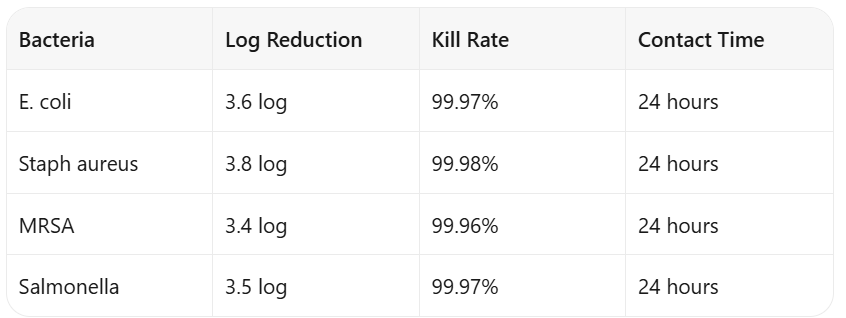
Important context: These are lab results under controlled conditions. In real-world hotel environments, the kill rate is influenced by cleaning frequency, surface temperature, and organic load (dirt, oil). But the key point is that the surface actively reduces bacterial load between cleanings.
Guest perception: Post-2020, cleanliness is the #1 factor in guest satisfaction surveys, above bed comfort and location. Hotels that communicate "antimicrobial surfaces" in guest rooms see a measurable lift in booking conversion.
Brand standards evolution: Here's what we're seeing from major chains:
Practical benefits for operators:
We recently supplied antibacterial solid surface for a 250-room AC Hotel by Marriott in Texas. The GM told us their post-cleaning ATP test scores (which measure surface cleanliness) were 40% lower on antibacterial vs. standard surfaces after 8 hours of guest use.
The price difference between standard and antibacterial solid surface breaks down like this:
45–70/sq ft installed52–82/sq ft installed — 15–18% premium
65–95/sq ft installed72–105/sq ft installed — 10–12% premium
Why the premium exists: The silver ion additive costs 1.50–3.00 per square foot. The rest of the premium comes from the manufacturing controls required — separate production lines to avoid cross-contamination, batch testing for efficacy, certification maintenance, and traceability documentation.
RoI calculation for a 150-room hotel:
19,000–34,0003,000–6,000 annuallyMost of our hotel clients recoup the premium within 12–18 months through operational savings and guest satisfaction improvements.
For maximum impact with minimum cost, prioritize these high-touch areas:
What about nightstands, desks, and other furniture-grade surfaces? Solid surface isn't typically used there. But for the surfaces where it is — bathroom and wet areas — antibacterial is becoming standard.
Antibacterial solid surface isn't magic. A few things to keep in mind:
Q: Does the antibacterial property wear off over time? A: No. The silver ions are distributed throughout the material, not just on the surface. As the surface is sanded or polished (during normal maintenance and refinishing), new silver ions are exposed. The antibacterial protection lasts the entire life of the product — 10+ years in hotel use. We have tested 8-year-old samples from hotel installations and they still meet ISO 22196 standards.
Q: Is antibacterial solid surface safe for food contact? A: Yes, when certified to NSF/ANSI 51. The silver ion technology used in Wiselink's antibacterial line is FDA-approved for food contact surfaces. Many hotel restaurants and bars use it for prep counters and bar tops. Just make sure your supplier provides NSF certification documentation.
Q: Can I get antibacterial solid surface in any color? A: Most manufacturers offer the full color range with the antimicrobial additive. However, some very dark colors can slightly reduce efficacy (the silver ions are partially absorbed by dark pigments). Light and mid-tone colors perform best. If you need a dark color with antibacterial protection, ask for the specific test data for that color.
Q: What's the difference between antibacterial solid surface and antimicrobial coating? A: Everything. An antimicrobial coating is a film applied to the surface after installation. It can wear off, wash off, and needs reapplication every 3–12 months. Antibacterial solid surface has the antimicrobial agent throughout the material — it can't wear off. In hotels where surfaces are cleaned daily with aggressive chemicals, coatings fail within weeks. We don't recommend coatings for any hospitality application.
Q: Does specifying antibacterial solid surface affect the lead time? A: Not significantly. Adding the silver ion masterbatch to the material formulation is done during manufacturing — it doesn't add process steps. At Wiselink, antibacterial orders ship on the same timeline as standard orders. The only difference is that we batch-test every production run for efficacy, which takes 48 hours and is done parallel to production, not sequentially.
Q: Is there a premium trend — will antibacterial become standard? A: We believe so. In 2020, antibacterial solid surface was a niche product. In 2025, it's 62% of our hotel orders. Marriott has already made it a brand standard for new builds. I expect that within 3 years, it will be the default specification in US hospitality, with non-antibacterial being a cost-down option. The price gap is narrowing as production scales.
Copyright © Guangdong Wiselink Ltd. -- Privacy Policy
 EN
EN