
The basin is the most-used surface in any hotel bathroom — and the most complained about when it's wrong. Solid surface basins solve three chronic problems: the mold-prone silicone joint of drop-in sinks, the clip-failure risk of undermount stone sinks, and the limited shapes of vitreous china. This guide covers the three main basin configurations — integrated, undermount, and vessel — with Guangdong Wiselink Ltd.'s field observations from supplying solid surface for thousands of hotel rooms.
Hotel operators often spend weeks choosing countertop material and five minutes picking the sink. That's backwards. The basin is where water, soap, toothpaste, hair products, and cleaning chemicals converge. It's where the guest interacts with the surface every single day. A bad basin choice creates maintenance calls, guest complaints, and accelerated replacement cycles.
Solid surface gives hotel buyers an option that vitreous china and stone don't: the integrated basin, where basin and countertop are one continuous material. No joint, no caulk, no mold.
An integrated solid surface basin is thermoformed from the same sheet as the countertop and chemically welded in place. After sanding and finishing, there is zero visible seam between the bowl and the countertop surface.
Why hotels choose integrated:
What to watch for:
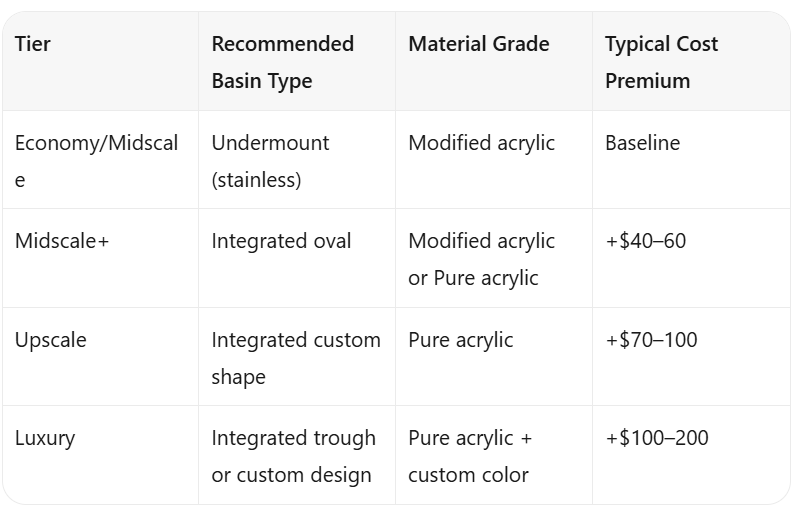
Wiselink's observation: For a 200-room hotel, the upfront premium for integrated basins vs. drop-in sinks is roughly $50–80 per vanity. The payback comes from zero re-caulking, zero sink replacement, and zero mold-related guest complaints over a 10-year lifecycle.
For projects where the budget doesn't stretch to fully integrated basins, an undermount basin fitted to a solid surface countertop is a strong middle option.
In this configuration, a separate basin (typically stainless steel or vitreous china) is mounted beneath a hole cut in the solid surface countertop. The solid surface edge around the cutout is polished smooth, and the basin is clipped underneath.
Pros:
Cons:
Best use case: Midscale hotels where cost matters more than absolute seamlessness, or projects where the countertop and basin are sourced from different suppliers.
Vessel basins — bowls that sit on top of the countertop rather than being set into it — are a design choice for boutique and lifestyle hotels that want a distinctive look.
The solid surface advantage:
The practical downside:
Wiselink's recommendation: Reserve vessel basins for public restrooms or suite-level bathrooms where design impact justifies the cleaning tradeoff. For standard guestrooms, integrated or undermount is more practical.
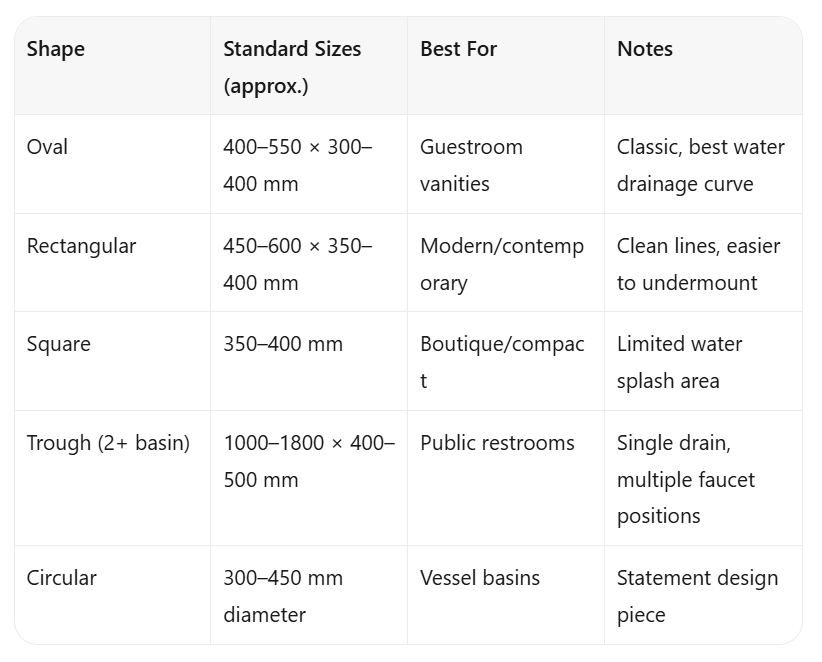
For standard hotel guestrooms, Wiselink sees 85% of integrated basins being oval or rectangular in the 400–550 mm range — deep enough to prevent splashing, wide enough for comfortable handwashing, and compatible with ADA knee-clearance requirements.
Commercial hotel bathrooms in the U.S. typically use:
Q: Are solid surface basins durable enough for hotel use? A: Yes. Solid surface basins have been used in commercial hospitality for decades. They're more impact-resistant than vitreous china (china chips; solid surface dents and sand repairs). They're less prone to staining than stone. The biggest risk is a dropped heavy object cracking the basin, but that's repairable with solid surface — not with china.
Q: Can an existing solid surface countertop be retrofitted with an integrated basin? A: No. Integrated basins must be fabricated as part of the countertop during manufacturing. Retrofitting requires removing the existing top and replacing it with a new integrated unit. Undermount basins can be retrofitted if the countertop is already cut for a basin.
Q: How do you clean a solid surface basin? A: Same as the countertop — non-abrasive cleaner and a soft cloth. For integrated basins, there's no caulk joint to scrub. For mineral deposits from hard water, use a diluted vinegar solution (1:4 with water) and rinse thoroughly.
Q: Does Wiselink supply pre-fabricated basin units? A: Guangdong Wiselink Ltd. supplies solid surface sheets to fabricators who build the basins. We also work with partner fabrication shops for pre-fabricated vanity tops with integrated basins. Contact us with your project volume for a complete solution.
Copyright © Guangdong Wiselink Ltd. -- Privacy Policy
 EN
EN