
Solid surface countertops are the default choice for mid-to-upscale commercial bathrooms for three reasons: seamless integration (no crevice for mold), repairability (scratches sand out, no replacement), and design flexibility (curves, integrated sinks, custom edge profiles). This guide covers thickness selection, edge profiles, integrated sink options, fabrication lead times, and real cost benchmarks — drawn from Guangdong Wiselink Ltd.'s experience supplying sheets for hotel, healthcare, and senior-living projects across the U.S.
Before we get into specs, let's be clear about why solid surface dominates commercial bathrooms while quartz and granite own residential kitchens.
Seamless = cleanable. In a hotel or hospital, the seam is where the problem lives. Mold, bacteria, and cleaning chemical residue all collect in seams. Solid surface countertops can be fabricated with chemically welded seams that become invisible after sanding — and with integrated sinks that eliminate the sink-rim joint entirely. A housekeeping team can wipe the entire surface in one pass, no crevices.
Repairable = replaceable less often. A guest scratches a quartz countertop? You live with it or replace the slab. A guest scratches solid surface? Maintenance sands it out with a Scotch-Brite pad in 10 minutes. Over a 10-year hotel lifecycle, that repairability translates to fewer replacements and lower total cost of ownership — even if the upfront material cost is similar.
Design-flexible = on-brand. Solid surface thermoforms into curves, can be routed into any edge profile, and takes custom inlays (logos, patterns, contrasting color strips). For a boutique hotel that wants a curved reception desk or a branded vanity edge, solid surface is the only material that delivers without a massive fabrication upcharge.
The most common question we get from first-time buyers: "What thickness do I need?" The answer depends on the application, not the budget.
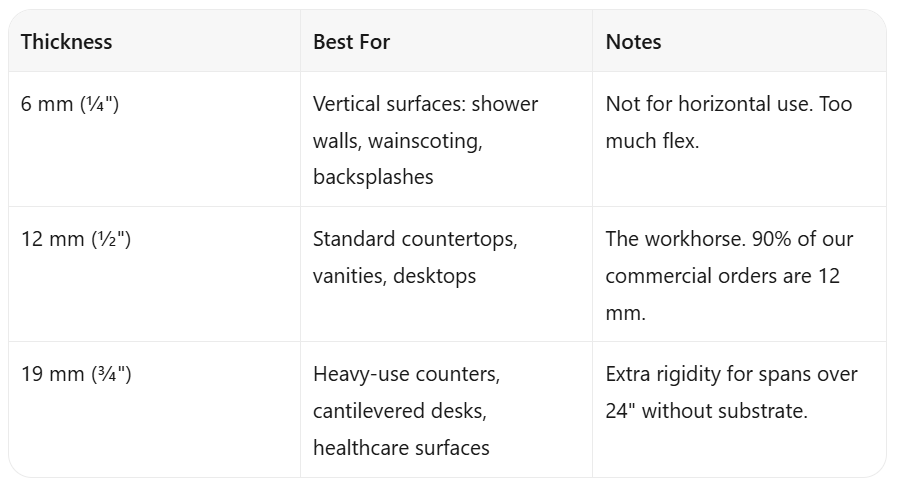
The 12 mm sweet spot: For a standard hotel vanity (24" deep, 36–48" wide) with plywood substrate, 12 mm solid surface is the industry default. It's thick enough to feel solid, thin enough to keep material cost reasonable, and fabricators are comfortable with it. Going to 19 mm adds roughly 50% to material cost and is rarely necessary unless the design calls for an unsupported cantilever.
Substrate matters: Solid surface countertops should always be installed over a moisture-resistant substrate — typically ¾" exterior-grade plywood. The substrate provides structural support; the solid surface provides the wear layer and seamless finish. Skipping the substrate to save money is a false economy — you'll get flex, cracking, and callbacks.
The edge profile changes the entire look of a countertop — and affects fabrication cost.
Wiselink's take: For a 200-key hotel, we recommend square or beveled edge on guestroom vanities (cost-efficient, clean) and save the waterfall or ogee edge for public-area counters where guests actually notice it. Nobody inspects the edge profile in room 317. They do notice the lobby desk.
The killer feature of solid surface countertops isn't the countertop — it's the sink. Because solid surface sinks are fabricated from the same material and chemically welded to the underside of the countertop, the result is a single monolithic surface with zero joints.
Why this matters for commercial bathrooms:
Fabrication note: Integrated sinks add about 1.5–2 hours of fabrication labor per unit compared to a flat countertop with a drop-in sink cutout. The material cost is roughly the same (you're using solid surface instead of a separate sink). For a 200-room hotel, that's 300–400 extra fabrication hours — significant, but worth it for the maintenance savings over 10 years.
These are approximate ranges based on Guangdong Wiselink Ltd.'s U.S. project experience. Actual costs vary by region, fabricator, and project volume.
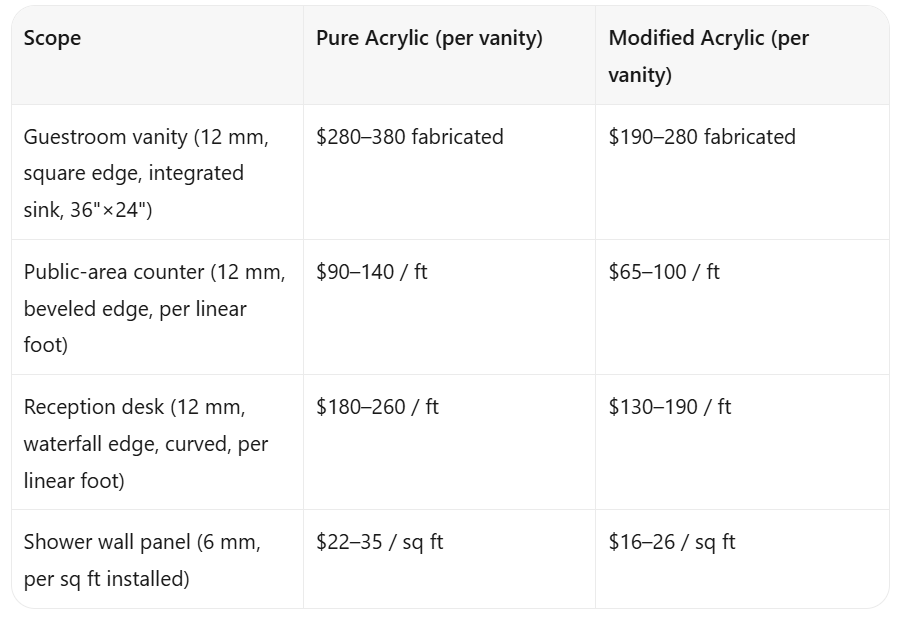
What drives cost variation:
From our experience coordinating sheet shipments with U.S. fabricators:
Pro tip: Order sheet 2–3 weeks before you think you need to. Container delays happen. A fabricator with material on hand is a fabricator who can start. A fabricator waiting on a container is a fabricator who's billing you for downtime.
Solid surface countertops are low-maintenance, not no-maintenance. Here's what hotel and facility managers should know:
Q: Can solid surface countertops be used in kitchens? A: Yes, but with caveats. Solid surface is not heat-resistant — a hot pan straight off the stove will leave a mark (repairable, but annoying). For commercial kitchens, stainless steel is still king. For hotel kitchenettes and residential-style suites, solid surface works fine if guests use trivets.
Q: How does solid surface compare to quartz for countertops? A: Quartz is harder (more scratch-resistant day-to-day) but not repairable. Solid surface is softer (scratches easier) but repairable. For commercial bathrooms, solid surface wins on seamless integration and repairability. For residential kitchens, quartz wins on perceived luxury. For a deeper comparison, see our Solid Surface vs Quartz vs Granite article.
Q: What colors are available? A: Wiselink offers 60+ standard solid colors and patterns — solid whites, stone-look aggregates, and custom color matching. The most popular commercial colors are warm white, cream, and light gray with subtle particulate patterns (they hide minor scratches best).
Q: Does solid surface stain? A: It resists most common stains — coffee, wine, makeup, hair dye, betadine. Strong dyes (hair color left overnight, permanent marker) can leave marks, but these can usually be sanded out. The key is wiping spills promptly, which is standard housekeeping protocol anyway.
Copyright © Guangdong Wiselink Ltd. -- Privacy Policy
 EN
EN