
Hotel bathroom vanities take a beating — water, cleaning chemicals, dropped hair tools, and 365 days/year of guest use. Solid surface has become the default material for mid-to-upscale hotel vanities because it solves problems that show up on the maintenance budget and the guest satisfaction score. Here are the six reasons, backed by real project data from Guangdong Wiselink Ltd.'s hospitality supply experience.
The number-one maintenance headache in hotel bathrooms isn't the toilet or the shower — it's the black mold that grows in the silicone joint between the countertop and the sink. Every drop-in sink has that joint. Every undermount sink in stone has it too (the clip gap collects moisture). Housekeeping can scrub it, but it comes back.
Solid surface integrated sinks eliminate that joint entirely. The sink bowl is thermoformed from the same sheet, chemically welded to the countertop underside, and sanded flush. There is no seam. There is no silicone bead. There is nowhere for mold to start.
What this means on the P&L: A 200-room hotel with drop-in sinks might have maintenance re-caulking 15–20 vanities per year due to mold complaints. At roughly 80–120 per re-caulk (labor + materials + room downtime), that's 1,200–2,400/year — plus the intangible cost of a guest posting a photo of a moldy sink on TripAdvisor. Solid surface eliminates that line item.
Hotel guests damage things. It's not malicious — it's just volume. 200 rooms × 365 nights = 73,000 guest-nights per year. Something will get scratched, burned, or stained.
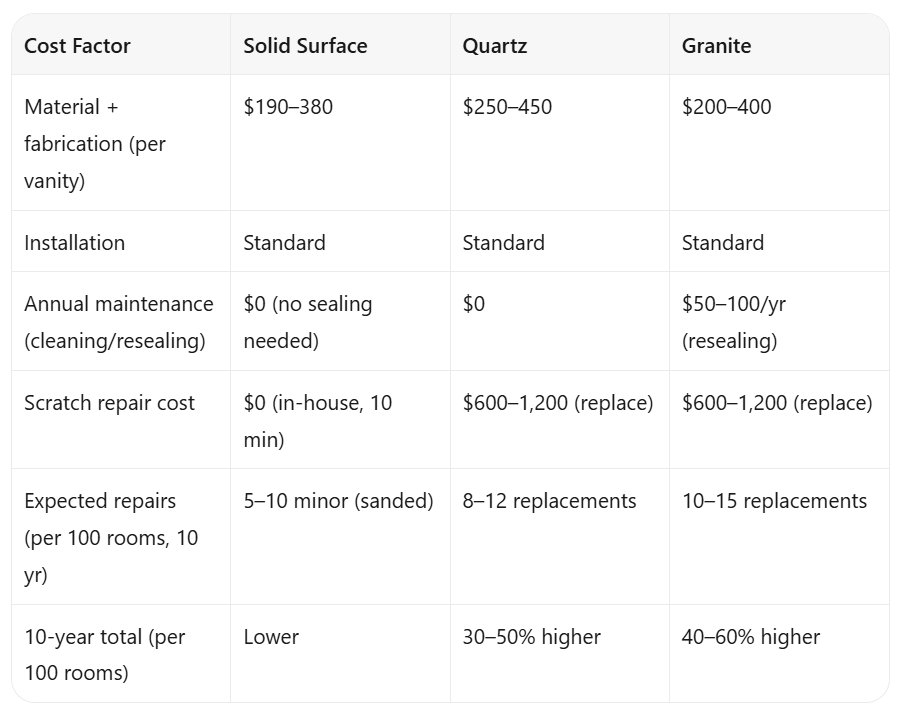
With quartz or granite: scratch it, live with it. Deep scratch, replace the slab. Replacement means: remove old countertop (labor), template new one (labor), fabricate new one (material + labor), install (labor), and lose 1–2 nights of room revenue. Cost: $600–1,200 per incident.
With solid surface: scratch it, sand it out. 10 minutes of maintenance labor. No replacement. No room downtime. No guest complaint.
One property manager at a Florida resort told us: "We budgeted for three vanity replacements a year. After switching to solid surface, we've done zero in four years. The maintenance guy just sands them during room turns."
What this means on the P&L: At one avoided replacement per year per 100 rooms, solid surface saves $600–1,200/year in direct replacement cost alone — plus the room revenue you didn't lose.
Boutique and lifestyle hotels want their bathrooms to look designed, not spec'd from a catalog. Solid surface delivers that flexibility without the custom fabrication premium that stone or quartz demands.
Wiselink has supplied custom-colored solid surface for a boutique hotel chain that wanted vanities to match their signature "Mediterranean blue" brand color. That's simply not possible with natural stone.
Upfront cost comparisons are misleading. The real comparison is 10-year total cost of ownership, including maintenance, repair, and replacement.
This one sounds soft but has hard implications. Stone countertops are cold to the touch. In a bathroom, where guests are barefoot and often undressed, that cold surface is subtly unpleasant. Solid surface is warmer to the touch — not heated, just not thermally conductive like stone.
It's a small thing. But hotel design is made of small things. The guest who leans their elbow on a warm vanity while brushing their teeth doesn't consciously notice it. The guest who flinches at a cold stone countertop does.
Solid surface also has a matte, soft-touch finish option that reads as more residential and less institutional. For hotels positioning themselves as "home away from home," that matters.
Hotels that use solid surface for vanities often end up using it elsewhere: shower wall panels, reception desks, bar tops, corridor wainscoting, elevator cab interiors. Once the fabricator is set up for solid surface, adding more scope is incremental.
From a supply chain perspective, this means:
We've seen this play out repeatedly: a hotel starts with "we need solid surface for vanities" and ends up adding shower walls and lobby desks once they realize the fabricator is already set up.
Full disclosure — solid surface isn't perfect for every hotel scenario:
Q: What thickness is standard for hotel vanities? A: 12 mm (½") solid surface over ¾" plywood substrate. This is the industry default for hospitality. 6 mm is too thin for horizontal use; 19 mm is overkill unless the vanity is cantilevered.
Q: How long does fabrication take for a hotel project? A: A 200-room hotel typically takes a fabrication shop 4–8 weeks, depending on complexity (integrated sinks add time) and shop capacity. We always recommend ordering sheet to arrive 2–3 weeks before fabrication is scheduled to start.
Q: Can Wiselink match a specific hotel brand color? A: Yes, Guangdong Wiselink Ltd. offers custom color matching. Lead time is 20–30 days for custom colors vs. 7–15 days for stock colors. Minimum order quantities apply for custom runs.
Q: What about ADA compliance? A: Solid surface vanities can be fabricated to meet ADA requirements for clear floor space, knee clearance, and rim height. The material itself is fully ADA-compatible. The key is the fabrication and installation spec, not the material choice.
Copyright © Guangdong Wiselink Ltd. -- Privacy Policy
 EN
EN