
Healthcare surfaces have one job: don't make people sicker. Solid surface is gaining share in hospitals, dental clinics, and senior living facilities for three reasons that have nothing to do with aesthetics: (1) seamless construction leaves no crevice for bacteria, (2) the surface handles hospital-grade disinfectants without degrading, and (3) when it does get damaged, it's repairable in place — no demolition, no infection control containment, no room shutdown. Guangdong Wiselink Ltd. has supplied solid surface sheets for healthcare projects across the U.S., and here's what the facility managers tell us.
Every seam in a countertop is a micro-habitat. Moisture collects there. Cleaning chemicals pool there and evaporate, leaving residue. Bacteria — including MRSA, C. diff, and VRE — can survive in those micro-crevices even after surface disinfection.
This is why healthcare design standards (FGI Guidelines, ANSI/ASHRAE/ASHE Standard 170) increasingly emphasize smooth, non-porous, seam-minimized surfaces in patient care areas. Solid surface with chemically welded seams and integrated sinks eliminates the crevices that laminate, tile, and even quartz (with its butt-joint seams) inevitably have.
One infection control director at a Midwest hospital told us: "We cultured the seam between the countertop and sink in an old patient room — the one with the laminate top and drop-in sink. We found organisms we don't even want to name. After switching to solid surface integrated sinks, same test came back clean."
Hospital environmental services teams use aggressive chemistry: quaternary ammonium compounds, hydrogen peroxide-based disinfectants, bleach solutions, and occasionally phenolic disinfectants for terminal cleaning. These chemicals destroy laminate over time (delamination at seams, surface etching). They etch natural stone. They discolor some quartz resins.
Solid surface — particularly pure acrylic solid surface — stands up to all of them. Here's the chemical compatibility data from Wiselink's in-house testing:
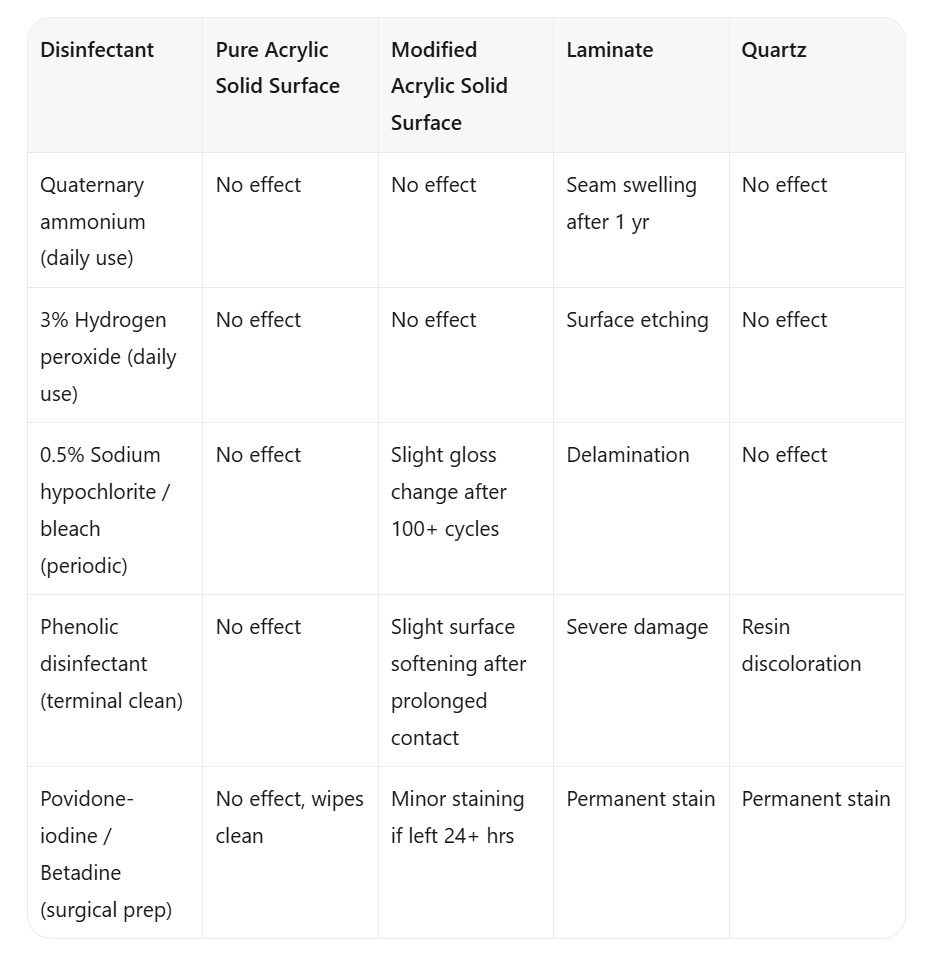
The practical takeaway: for daily and periodic disinfection with standard hospital chemistry, pure acrylic solid surface is effectively inert. Modified acrylic holds up well but may show subtle changes under the most aggressive protocols. For ICUs, operating rooms, and isolation rooms, we recommend pure acrylic.
Healthcare surfaces get damaged. Gurneys bump into countertops. IV poles scrape edges. Surgical instruments get dropped. In a laminate or quartz world, damage means one of two things: live with it (compromising infection control) or replace it (expensive and disruptive).
Solid surface damage gets repaired in place:
Compare this to replacing a quartz or laminate countertop in a functioning patient room: infection control containment, demolition dust, construction crew in the clinical area, room out of service for 1–3 days. The cost isn't the countertop — it's the downtime.
Senior living facilities — independent living, assisted living, and skilled nursing — are quietly becoming one of the largest solid surface markets. Here's why:
Aging in place means bathroom safety. Solid surface vanities can be fabricated with rounded corners (no sharp edges for fall injuries), integrated grab bar blocking (structural reinforcement built into the substrate), and wheelchair-accessible knee clearance. These are standard ADA/UFAS requirements that solid surface handles gracefully.
Incontinence and cleaning. Senior living bathrooms deal with bodily fluids that commercial hotels rarely see. Solid surface is non-porous — urine, feces, and cleaning chemicals sit on the surface and wipe away completely. No absorption. No residual odor. Try saying that about grouted tile.
The "home-like" mandate. CMS and state regulators increasingly require senior living facilities to look residential, not institutional. Solid surface vanities with warm colors and matte finishes read as "nice apartment bathroom," not "hospital room." That matters for resident dignity and family satisfaction.
One Midwestern senior living operator who switched 12 properties to Wiselink solid surface vanities told us the decision came down to three words from their maintenance director: "I can sand it." Everything else — infection control, aesthetics, durability — was secondary to the fact that damage didn't mean replacement.
The most common healthcare applications we see:
If you're specifying solid surface for a healthcare project, here's what Guangdong Wiselink Ltd. recommends based on 12 years of supplying these jobs:
Q: Is solid surface more expensive than laminate for healthcare? A: Upfront, yes — roughly 2–3× the material cost. Over a 10-year lifecycle including replacement of failed laminate (which happens at seams in healthcare environments), solid surface is cheaper. The breakeven is typically year 4–6.
Q: Does solid surface meet FGI Guidelines? A: Yes. Solid surface meets the FGI requirement for smooth, non-porous, cleanable surfaces in patient care areas. It also meets ANSI/ICPA SS-1, the industry standard for solid surface materials.
Q: Can solid surface be used in operating rooms? A: Pure acrylic solid surface can be used for OR countertops and work surfaces. It is not typically used for OR wall cladding (stainless steel or epoxy-coated surfaces are more common there), but for counters, sinks, and workstations within the OR suite, it's an appropriate material.
Q: What about behavioral health / psych facilities? A: Solid surface can be fabricated with anti-ligature profiles (rounded edges, no exposed mounting hardware) for behavioral health environments. This is a specialized fabrication requirement — discuss it with your fabricator during the submittal phase.
Q: Does Wiselink have healthcare-specific colors? A: Guangdong Wiselink Ltd. offers a range of neutral, warm-white, and light-gray colors that are standard in healthcare. We can also custom-match institutional color standards. Contact us with your spec.
Copyright © Guangdong Wiselink Ltd. -- Privacy Policy
 EN
EN