Guangdong Wiselink Ltd.

Solid Surface Shower Base vs Tile Shower Pan: Commercial Comparison

Time : 2026-07-15

Solid Surface Shower Base vs Tile Shower Pan: Commercial Comparison

Executive Summary (TL;DR)

The shower base is the most leak-prone element in any hotel bathroom. Tile shower pans have multiple potential failure points: the pan liner, the mortar bed, the grout lines, and the drain seal. Solid surface shower bases are a single molded piece — one material, one drain connection, zero joints. Guangdong Wiselink Ltd. supplies solid surface sheet that fabricators use to manufacture shower bases, and here's the data-driven comparison for commercial specifiers.


The Tile Shower Pan Problem

A tile shower pan is built from multiple layers: pre-slope, PVC or CPE liner, mortar bed, thinset, tile, and grout. That's six layers with multiple failure points.

Common failure modes in commercial tile shower pans:

  • Liner puncture — during mortar bed installation, a stray nail or sharp aggregate punctures the liner. Leak starts behind the tile, invisible until damage is extensive.
  • Grout failure — grout in a shower floor takes constant water exposure. It cracks, spalls, or erodes within 3–5 years in commercial use.
  • Pan-to-wall joint failure — the silicone joint where tile meets tile at the wall-floor intersection. This joint fails annually in many installations.
  • Drain seal failure — the weep holes in a tile pan drain can clog, causing water to pool under the tile bed.

Each failure requires demolition to repair: remove tile, remove mortar bed, replace liner, re-install. Cost per repair: $1,500–3,000 minimum, plus 3–5 days of room downtime.


The Solid Surface Shower Base Advantage

A solid surface shower base is a single molded or fabricated piece, typically with a textured bottom surface and a pre-formed slope to the drain.
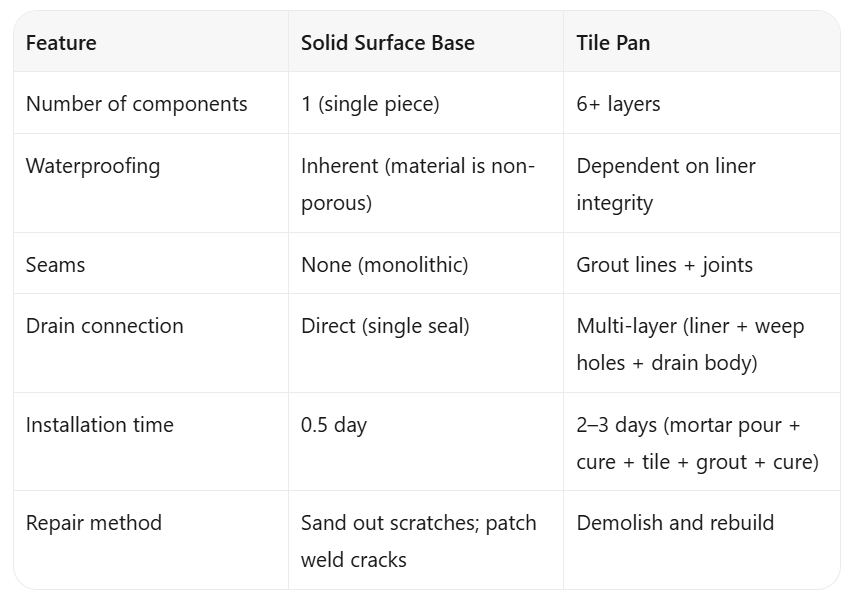
Solid Surface Shower Base vs Tile Shower Pan: Commercial Comparison

Installation Comparison

Solid surface shower base installation:

  1. Subfloor prepared (level, waterproof membrane applied)
  1. Base set in mortar bed or adhesive bed (for leveling)
  1. Drain connected (standard 2" or 3" connection)
  1. Wall panels installed overlapping the base flange
  1. Silicone bead at wall-base junction
  1. Ready for use in 24 hours

Tile pan installation:

  1. Subfloor prepared, pre-slope poured
  1. PVC/CPE liner installed, drain connected, flood test (24 hours)
  1. Top mortar bed poured and sloped to drain (24–48 hour cure)
  1. Thinset and tile installed (1–2 days)
  1. Grout installed and sealed (1 day + cure)
  1. Silicone at pan-wall joints
  1. Ready for use in 4–5 days

Cost Comparison

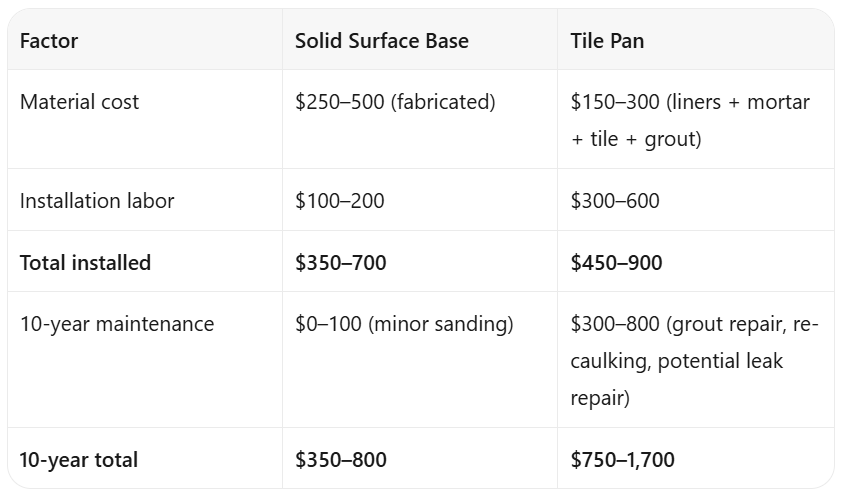
Solid Surface Shower Base vs Tile Shower Pan: Commercial Comparison

The solid surface base costs about the same or slightly less upfront compared to a tile pan when all installation labor is included. Over 10 years, the maintenance savings are significant.


When to Choose Each

Spec solid surface shower base when:

  • Waterproofing reliability is critical (senior living, healthcare, multi-story hotels)
  • Construction schedule is tight (saves 2–3 days per bathroom)
  • Accessibility / barrier-free design is required (solid surface bases can be curbless)
  • Maintenance team prefers simple repair protocols

Spec tile shower pan when:

  • The designer insists on a specific tile pattern on the shower floor
  • The shower size is non-standard (oversized or irregular shape)
  • Budget for the base itself is the primary concern (tile pan material is cheaper, though labor offsets this)
  • The property has a maintenance team experienced with tile pan repairs

Barrier-Free (Curbless) Shower Bases

ADA and UFAS accessibility standards increasingly require barrier-free showers in commercial properties — particularly senior living and healthcare. Solid surface shower bases are ideal for curbless installations because:

  • The base can be fabricated with a pre-slope that meets the ½" per foot ADA requirement
  • The single molded piece eliminates the curb (the traditional trip hazard in a tile pan shower)
  • The surface is non-slip when textured
  • Installation integrates with a linear drain for a modern look

Many senior living and accessible hotel rooms now specify solid surface barrier-free bases as the standard.


FAQ

Q: Are solid surface shower bases slippery when wet? A: Standard solid surface has a smooth finish that can be slippery. For shower bases, specify a textured finish (embossed pattern or grit additive). Wiselink's shower base sheet can be fabricated with a slip-resistant texture that meets ADA friction coefficient requirements.

Q: What size do solid surface shower bases come in? A: Typical sizes: 32×60", 36×60", 36×48", 42×60", 48×60". Custom sizes can be fabricated. The maximum size depends on sheet availability and fabrication capability.

Q: Can a solid surface shower base be installed on a second floor? A: Yes. The base itself weighs less than a tile-and-mortar pan, which is an advantage for upper-floor installations. The subfloor must still be designed for the expected load (standard bathroom live load: 40 psf).

Q: How long do solid surface shower bases last? A: With proper installation and maintenance, 20+ years. The material is repairable — scratches and stains sand out. If the drain seal eventually fails, the base itself can be reused with a new drain assembly.


Related Articles

solid surface shower base vs tile shower pan-0

Get a Free Quote

Our representative will contact you soon.
WhatsApp
Email
Tel
Name
Message
0/1000
solid surface shower base vs tile shower pan-0

Get a Free Quote

Our representative will contact you soon.
WhatsApp
Email
Tel
Name
Message
0/1000