
Picture two different settings. In one, a family kitchen on a weekday morning: a toddler spills orange juice across the island and a hot frying pan accidentally slides off the trivet onto the counter. In the other, a boutique hotel breakfast buffet: a waiter wipes down the long serving counter dozens of times an hour, scrubbing away coffee splashes and greasy butter residue. In both scenarios, the countertop material makes or breaks the moment. Granite, for all its natural grandeur, is a porous stone. If the sealer has worn thin, that orange juice etches into the calcite veins and leaves a dull ghost mark that cannot be wiped away. The hot pan can cause a thermal shock crack along a hidden mineral fissure. Solid surface, by contrast, is engineered from acrylic or polyester resins blended with mineral fillers to be non porous all the way through. That same spill stays on top of the material, and a quick wipe restores a perfectly clean surface. The difference in daily life between managing a sealed stone and owning a uniformly repairable surface becomes clear very quickly when real accidents happen.
The fundamental technical divide between these two materials lies in their relationship with liquids. Granite is a natural igneous rock with a crystalline structure. Under a microscope, the surface of even a polished granite slab is a network of micro fissures, capillary pores, and grain boundaries. This is why the stone must be treated with an impregnating sealer that chemically bonds inside those capillaries. That sealer does not last forever. In a busy hotel environment, aggressive cleaning chemicals and constant abrasion strip the sealer faster than a typical homeowner would ever expect, requiring a professional resealing cycle that temporarily removes the counter from service. Solid surface eliminates this entire maintenance category. Its acrylic or polyester matrix is inherently non porous, meaning there are no capillary pathways for red wine, beet juice, or chemical cleaners to travel down into the body of the material. This same non porous quality also prevents the growth of stain causing mold or bacteria within the counter itself. When a hotel manager calculates the operational cost of shutting down a breakfast station for resealing versus simply wiping a surface down, the technical advantage of a non porous engineered material becomes a tangible operational benefit.
Anyone who has run their hand along a granite countertop seam has felt it. Even with the best color matched epoxy, a seam in natural stone almost always registers as a tactile break in the surface. For kitchen islands that require multiple slabs, or for hotel reception desks that stretch across a lobby, these seams interrupt the visual flow. Solid surface fabrication operates on a completely different principle. The material can be cut with standard woodworking tools and joined with a two part color matched adhesive that chemically welds the pieces together. Once the adhesive cures, the fabricator sands the entire area flush. The result is a monolithic surface where the seam disappears visually and physically. This property extends to edge profiles. Solid surface sheets can be heated and thermoformed into curves, waterfall edges, and integrated sinks that are impossible to achieve with a rigid, brittle stone slab. For a hotel designer trying to create a dramatic, curved check in desk without visible joints, solid surface offers a level of fabrication flexibility that granite simply cannot match without exposing unsightly seam lines.
When regulatory bodies and design authorities write guidelines for commercial food preparation surfaces, they almost always prioritize the absence of cracks, crevices, and unsealed joints. The scientific reasoning is straightforward: bacteria need a place to harbor, and a porous or seamed surface provides exactly that. This is why high traffic hospitality environments, cruise ship galleys, and healthcare pantry stations have largely moved toward seamless, non porous surface technologies. Granite can be specified in these settings, but it comes with strict maintenance covenants and a higher burden of proof for sanitation compliance. Solid surface, by conforming to these hygiene standards from its material structure outward, removes a layer of operational risk. For a hotel operator, specifying a material that aligns with Hazard Analysis and Critical Control Point principles means passing health inspections with fewer contingencies. For a homeowner, it means the reassurance that raw chicken juices wiped across a solid surface prep zone will not leave a biological residue hiding in a seam or a pore, which is exactly the level of hygiene confidence that modern living demands.
A transparent cost conversation must acknowledge that high grade exotic granite carries a cachet and a natural patterning that solid surface cannot exactly replicate. In a luxury residential sales listing, a rare slab of Blue Bahia or Calacatta marble sets a certain tone. However, the ownership cost extends far beyond the initial purchase. Granite requires periodic sealing. It can chip at the sink edge if a heavy pot is dropped. Repairing that chip on site is a specialized stone restoration job that leaves a slightly different polish level. Solid surface, by contrast, is renewable. Scratches, burns, and even deep gouges can be sanded out with progressively finer abrasives and restored to the original factory matte or gloss finish by a competent maintenance technician, often without removing the counter from its base. In a hotel renovation scenario, this means a damaged check in counter can be repaired between the morning checkout rush and the afternoon arrivals, with zero demolition dust and no replacement slab delivery delay. That reduction in operational downtime frequently tips the financial argument in favor of an engineered surface for properties where continuous operation is non negotiable.
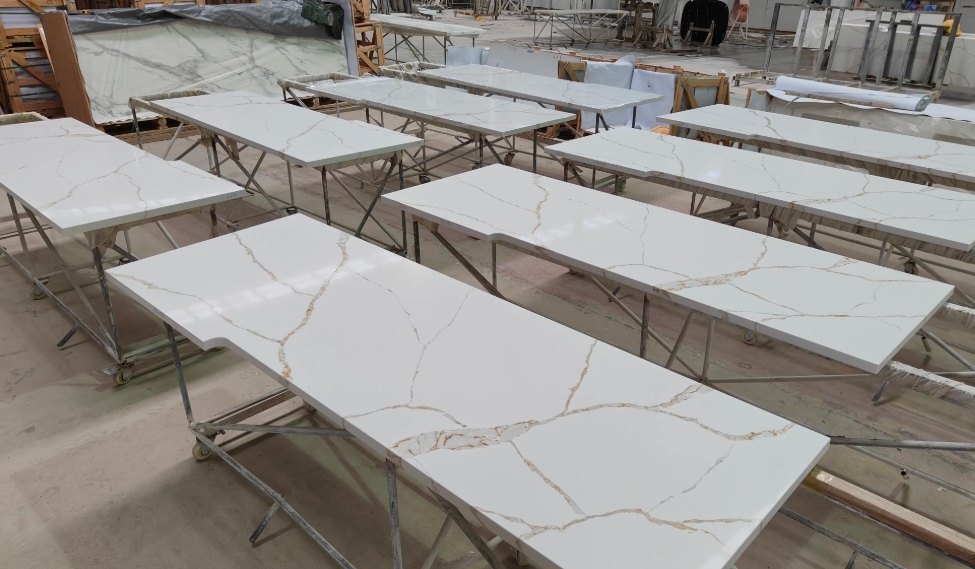
All of these technical and practical advantages depend on one factor that owners often overlook: the quality of the solid surface sheet itself. A solid surface counter is only as non porous and color consistent as the manufacturing process that produced it. If resin and filler are not mixed to precise ratios, the material can develop micro voids or color swirls that ruin the seamless visual effect. If the sheet thickness varies, the thermoforming process becomes unpredictable. This is where supply chain control and factory floor discipline become the most important part of the specification. Wiselink maintains a tightly managed production environment where the composition, curing, and dimensional calibration of every sheet are verified before distribution. When a hotel developer or a residential kitchen contractor orders solid surface sheets, the certainty of that quality means the joinery will be invisible, the color batch will match, and the material will perform as the engineering data promises. That level of reliability turns a material comparison on paper into a successful, long lasting installation on site.
Copyright © Guangdong Wiselink Ltd. -- Privacy Policy
 EN
EN