
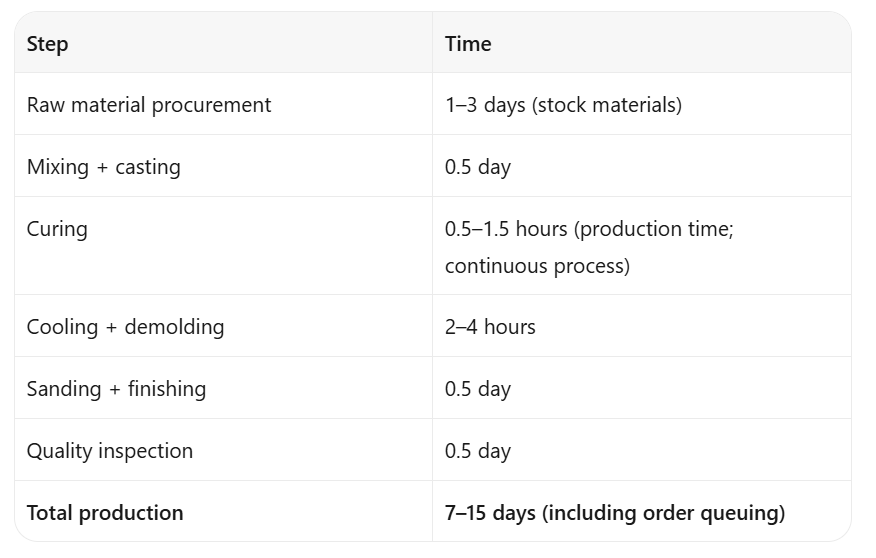
Understanding how solid surface sheet is made helps buyers evaluate suppliers, set realistic lead time expectations, and identify quality indicators. The process involves six main steps: raw material mixing, casting, curing, demolding, sanding/finishing, and quality inspection. Each step affects the final sheet quality.
The process starts with two primary ingredients:
Additional components include: pigments (for color), initiators (to trigger curing), release agents, UV stabilizers, and additives for specific properties (anti-static, anti-bacterial).
The ingredients are weighed, batched, and mixed in high-shear mixers until homogeneous. Mixing time and temperature affect color consistency and void formation.
The liquid mixture is poured into molds. Two methods:
Batch casting: The mixture is poured into individual mold frames (typically 3050×760 mm or 3680×760 mm) on a horizontal casting line. Each mold is vibrated to release air bubbles.
Continuous casting: The mixture is poured onto a moving belt between two carrier films. This method produces longer sheets but requires more precise viscosity control.
Wiselink uses batch casting for standard sheet sizes — this allows better quality control on thickness tolerance and surface finish.
The filled molds enter a curing oven or tunnel. The curing cycle converts the liquid resin into a solid sheet through polymerization.
Curing parameters:
Pure acrylic requires a longer, more carefully controlled cure than modified acrylic. Rushed curing creates internal stress that manifests as warping or micro-cracking.
After curing, the sheet must cool before demolding. Rapid cooling can cause thermal shock and warping. Sheets are typically allowed to cool to room temperature over 2–4 hours.
After demolding, the sheet may have a rough back surface (from the mold) and a smoother front surface (from the carrier film).
The sheet passes through a multi-head sanding line:
Thickness tolerance should be ±0.2 mm on 12 mm sheet after sanding. Premium manufacturers hold tighter tolerances.
Each sheet is inspected for:
Wiselink ships sheets with a batch number and inspection certificate traceable to the production date and shift.
Q: What distinguishes a good manufacturer from a bad one? A: Three things: (1) thickness tolerance — good manufacturers hold ±0.2 mm or better, (2) color consistency across production runs, and (3) sample testing frequency — quality manufacturers test per batch, not per month.
Q: Can the process create custom colors in small quantities? A: Custom colors require lab formulation and dedicated production line cleaning. Minimum typically 100+ sheets for cost-effective custom runs.
Q: How do I verify a manufacturer's quality claims? A: Request: product data sheet (with ASTM/ANSI test results), photos of the production line, quality control documentation, and samples from the current production run. A walk-through video tour is also a strong signal.
Copyright © Guangdong Wiselink Ltd. -- Privacy Policy
 EN
EN